Oddělení bioanalytické instrumentace
The department focuses on improving existing devices and methods for the analysis of biologically significant compounds. In the construction of device prototypes, the department employs advanced micromachining technologies and lithographic processes available directly within its facilities. At present, the team is particularly engaged in applied research on the protein composition of breast cancer cells, the analysis of selected substances contained in samples obtained by non-invasive methods, and the study of conformations of peptide-based therapeutics.
The current main areas of expertise include:
Design and development of electromigration methods:
- Concentration and purification of large-volume samples based on the principle of isotachophoresis
- Development of interfaces for detection by mass spectrometry, surface-enhanced Raman spectroscopy, and amperometry
- Separation in heavy water
- Portable and open-source electrophoresis
Development of synthetic procedures for nanoparticles and their applications:
- Silver and gold nanoparticles (surface-enhanced Raman spectroscopy, affinity capture)
- Magnetic nanoparticles
Fabrication of microfluidic devices and related accessories:
- Acoustofluidics
- Microfluidic electrophoresis
- Microfluidic devices for electrospray generation
- Doc. RNDr. Petr Kubáň, Ph.D. - vedoucí oddělení petr.kuban@iach.cz (+420) 532 290 142 Publikace

- Mgr. Jan Přikryl, Ph.D. - zástupce vedoucího prikryl@iach.cz (+420) 532 290 107 Publikace
- Ing. František Foret, DSc. foret@iach.cz (+420) 532 290 242 Publikace
- Ing. Janette Bobáľová, CSc. bobalova@iach.cz (+420) 532 290 106 Publikace
- Mgr. Júlia Lačná, Ph.D. lacna@iach.cz (+420) 532 290 232
- Mgr. Jakub Novotný, Ph.D. novotnyj@iach.cz (+420) 532 290 145 Publikace
- Mgr. et Mgr. Vít Pavelka, Ph.D. pavelka@iach.cz (+420) 532 290 145
- Ing. Mgr. Roman Řemínek, Ph.D. reminek@iach.cz (+420) 532 290 105 Publikace
- Ing. Dana Strouhalová, Ph.D. strouhalova@iach.cz (+420) 532 290 215 Publikace
- Mgr. Anna Týčová, Ph.D. tycova@iach.cz (+420) 532 290 201 Publikace
- Mgr. Ivona Voráčová, Ph.D. voracova@iach.cz (+420) 532 290 236 Publikace
- Mgr. Jan Badin, badin@iach.cz (+420) 532 290 236 Publikace
- Mgr. Lucie Březinová brezinova@iach.cz (+420) 532 290 236
- Mgr. Jiří Volánek volanek@iach.cz (+420) 532 290 143 Publikace
- Prof. Andras Guttman https://richem.hu/en/staff-and-contact.html
- Prof. Yan Liushui www.ncu.edu.cn
- Prof. Doo Soo Chung http://bachem.snu.ac.kr/professor.html
- Ing. Vanda Kocianová
- Mgr. Vladimír Jonas
- Mgr. Petra Trembecká
- Mgr. Michael Killinger, DiS.
- Mgr. Tomáš Václavek
- Mgr. Helena Hrušková
- Ing. Karel Klepárník, CSc. - emeritní vědecký pracovník kleparnik@iach.cz Publikace
- Mgr. Markéta Procházková
- Eva Adamová, Ph.D. http://www.uthsc.edu/PhDA/fellows.php
- Barbora Belšánová www.genomac.com
- Ing. Dagmar Benkovská, Ph.D.
- Mgr. Vladimíra Datinská, Ph.D.
- Lucie Hanzlíková www.genomac.com
- Mgr. Jitka Hegrová, Ph.D. http://www.cdv.cz
- Ing. Věra Hezinová, Ph.D. http://fvhe.vfu.cz/adresa/sekce_ustavy/ubchbf/
- Gabor Jarvas http://englishweb.uni-pannon.hu/
- Mgr. Petra Jusková, Ph.D. http://umr168.curie.fr/en/MMBM-group
- Vratislav Košťál, Ph.D. www.tescan.com
- Mgr. Petr Kusý, Ph.D.
- Bc. Ondřej Laskafeld
- Marcela Liskova, Ph.D. http://www.uskvbl.cz/cs
- Ing. Jaroslav Luksch http://www.doosanskodapower.com/en/main.do
- Ing. Denisa Maděránková http://www.dbme.feec.vutbr.cz/
- Ing. Jiří Obalil http://www.envipo.cz/
- Mgr. Marek Otevřel, Ph.D. http://pitz.desy.de/index_eng.html
- Mgr. Jan Partyka, Ph.D
- Pavel Podešva, Ph.D. http://www.xjtu.edu.cn/
- Mgr. Anna Potacova
- Mgr. Petr Smejkal http://www.utas.edu.au/chemistry/people
- Ing. Michal Spěšný, Ph.D. http://www.erbalachema.com/
- Monika Stankova
- Mgr. Petr Šenk
- Hana Raszkova
- Mgr. Roman Tomáš, Ph.D. http://www.kapitol.cz/
- Anna Týčová https://analytik.chemie.uni-leipzig.de/start/ak-prof-belder/
- Michal Vašina, http://loschmidt.chemi.muni.cz/peg/category/people/
- Ing. David Vlk http://www.gml.cz/
- Mgr. Jitka Žídková, Ph.D.
Access to our instrumentation is available by prior arrangement. Our facilities can be utilized for contract analyses or preliminary testing to assess method suitability. For further details, please contact us (petr.kuban@iach.cz).
Capillary Electrophoresis (Agilent 7100)
Capillary electrophoresis with UV-VIS detection and C4D detection. Applicable for broad range of separation modes such as CZE, CGE, CIEF, MEKC, ITP, CEC.
KEY SPECIFICATIONS
- Voltage range: 0-30 kV
- Deuterium lamp
- Diode array detector
- Sample loading: pressure as well as electrokinetic
- Autosampler capacity: 50-position carousel
Fragment Analyzer (Agilent, FA 5200)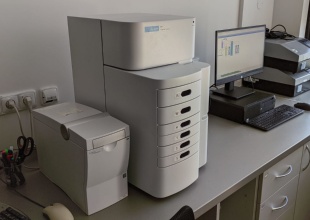

Capillary electrophoresis with fluorescence detection allowing separation of 12 samples in parallel. The system is designed for DNA and RNA quality control.
KEY SPECIFICATIONS
- Excitation wavelength: 408 nm (LED)
- Up to 12 samples per run
- Load up to three 96-sample microplates
- 3 different capillary array lengths
- Load 2 different gels within one system setup
Bioanalyzer (Agilent)
Microfluidic chip electrophoresis for DNA, RNA and protein analysis.
KEY SPECIFICATIONS
- Fluorescence detection (red, LED)
- Up to 12 samples per run
Electrophoretic analyser (EA 102, Villa Labeco

The modular arrangement of this analyser enables its application with several electrophoretic modes of operation e.g. isotachophoresis (ITP), capillary zone electrophoresis (CZE), or the highly efficient combination of ITP – CZE.
KEY SPECIFICATIONS
- Preseparation column with contact conductivity detectors employing FEP capillaries
- Analytical column with contact conductivity detector
- Variable column lengths
- Max. voltage 15kV
- Max. current 500 microamperes
- UV detector (200, 220, 254, 280 nm )
- ITP injection valve (30 microliters)
- Variable injection volume via microsyringe facility (up to 100 microlitres)
- CZE and micro-preparative injection valve – optional
Gel Electrophoresis
KEY APPLICATIONS
- Proteomic analysis of complex biological samples
- Detection of specific proteins and post-translational modifications
- Comparative studies of protein expression between samples
- Protein quantification
Epitachophoresis

Electroseparation and concentration method based on a discontinuous electrolyte system. Enables the separation and concentration of large sample volumes up to tens of mL. Enables separation of anions (e.g. DNA) or cations (e.g. proteins).
(Detailed parameters provided in DOI 10.1038/s41598-021-02214-1)
Microfluidic Capillary Electrophoresis (in-house constructed)

Capillary electrophoresis implemented on a borosilicate glass chip (typically 5×5 cm), which is well suited for optical detections. The shape (length, depth) and layout of the channels can be modified according to the given application.
The separation voltage is applied from a high-voltage source with multiple independent outputs
Portable Capillary Electrophoresis (in-house constructed)
(Detailed parameters provided in DOI 10.1016/j.chroma.2015.11.088)
CNC Milling Machine 40×60

General-purpose desktop CNC milling machine for prototyping and fabrication of parts from plastics, wood and soft metals. Ideal for prototyping, custom part production such as PCBs, molds, fixtures and custom components.
Working area approximately 400 × 600 mm. Computer-controlled 3-axis motion for precise routing and profile milling. Supports common CAM/CAD toolpaths and control software.
FDM 3D Printer (MK3S, Prusa)
Fused deposition modelling (FDM) 3D printer with robust feature set suited for prototyping and functional part fabrication. Renowned for reliability, adaptive calibration and wide material compatibility. Build volume 250 × 210 × 210 mm. Layer heights 0.05 – 0.35 mm, heated print bed with removable PEI steel sheet. Filament diameter 1.75 mm supporting PLA, PETG, ABS and other common thermoplastics.
DLP 3D Printer (Photon, Anycubic)
Digital Light Processing (DLP) resin 3D printer capable of high-resolution additive manufacturing from photopolymer resins. Especially suitable for detailed models, microstructures and smooth surface finishes. Uses LCD masked UV projector to cure resin layer by layer. Build volume 115 × 65 × 155 mm. Layer heights 0,025 – 0,1 mm. High XY resolution defined by pixel size of the imaging panel. Ideal for miniatures, dental models, jewelry patterns and precise prototypes.
Nanospray Tips Grinder

Precision grinding and polishing station for preparing nanospray emitter tips used in nanospray ionization; enables fine shaping and consistent tapering of capillary tips to achieve stable spray and optimal ionization performance.
(Detailed parameters provided in DOI 10.1002/elps.201500467.)
Cutting Plotter (FC50, Secabo)
Desktop flatbed cutting plotter for precision contour cutting of plastic foils, paper, cardboard and similar media. Includes professional cutting software and vacuum fixation for stable material handling. Working area up to 350 × 520 mm, max thickness ~1.5 mm, cutting speed up to ~600 mm/s. Compatible with DrawCut PRO cutting software – import and process vector graphics.
Laser Cutter (Nova 24, Thunderlaser)
Mid-format CO₂ laser cutting and engraving system with enclosed design, suitable for cutting and engraving a variety of non-metal materials, such as wood, acrylic, plastics, textiles and others. Desktop-friendly size with safety features and integrated control software. Working area ~600 × 400 mm. Sealed CO₂ laser tube (100 W). CNC motion system with hybrid servo motors for high precision and speed.
Sandblasting Box (BP-4263, BASS Polska)
Enclosed abrasive blasting cabinet for surface roughening and cleaning. Integrated viewing window and glove ports allow controlled abrasive media projection onto sandblasted components.
Spectrofluorometer (JASCO, FP-8500)
Spectrofluorometer for sensitive fluorescence measurements, enabling acquisition of excitation and emission spectraas well as rapid 3D fluorescence scans.
 KEY SPECIFICATIONS
- 150 W xenon arc lamp excitation source
- Photomultiplier tube (PMT) detector
- Signal-to-noise ratio: up to 75,000:1 (RMS, water Raman)
- Scanning speed: up to 60,000 nm/min
- Wavelength range: 200–750 nm (extendable to 850 nm)
- Spectral resolution: up to 1.0 nm
Fluorescence Microscope (Olympus, IX71)
A modular inverted research microscope specialized for imaging of cell cultures and biological samples. The system supports brightfield, transmitted-light, and epifluorescence microscopy.
 KEY SPECIFICATIONS
- Olympus TH4-200 halogen transmitted-light source
- Lumen Dynamics X-Cite Series 120Q metal-halide fluorescence light source
- Filter sets: U-MWU2, U-MWIBA3, U-MWG2, U-N69002
- Andor Zyla 4.2 PLUS sCMOS camera (4.2 MP)
- Olympus XM10 cooled monochrome CCD camera
Particle Size and Zeta Potential Analyzer (Malvern Zetasizer Nano ZS, ZEN3600)
An instrument for characterization of nanoparticles, colloids, and macromolecules in liquid dispersions. It enables measurement of particle size, zeta potential, and molecular weight using dynamic, electrophoretic, and static light scattering techniques.
KEY SPECIFICATIONS
- Particle size range: approx. 0.3 nm – 10 µm
- Temperature control range: 0–90 °C
- Measurement technologies: Dynamic Light Scattering (DLS), Electrophoretic Light Scattering (ELS), Static Light Scattering (SLS)
UV-Vis Spectrophotometer (Shimadzu, UV-1800)
A double-beam UV-Vis spectrophotometer that offers high resolution over a wavelength range of 190 to 1100 nm. The instrument enables spectral acquisition, quantitative photometric analysis, and kinetic (time-course) measurements.
KEY SPECIFICATIONS
- Double beam type
- Light sources: tungsten-halogen and deuterium lamps
- Spectral bandwidth: 1 nm
- Wavelength range: 190–1100 nm
- Wavelength accuracy: ±0.3 nm (entire range)
- Scanning speed: 2–3000 nm/min
Coming soon.
Scanning Electron Microscopy (Mira3, Tescan)
Electron microscope suitable for imaging the surface structure of materials. Two types of detectors are available: SE and In-Beam SE.
A coating (sputtering) technology for sample metallization is available.

Confocal Raman microscope (Renishaw inVia Reflex)
The Renishaw inVia Reflex is a research-grade confocal Raman microscope. The system is suitable for Raman and photoluminescence (PL) spectroscopy, point analysis and chemical mapping of a wide range of solid and liquid samples.
Excitation is provided by three lasers: 532 nm (50 mW) and 633 nm (30 mW), and 785 nm (300 ± 30 mW nominal). Two optical geometries are available: an upright path with a manual microscope and a parallel output beam coupled to a manual inverted microscope by Leica Microsystems.
Spectral dispersion is provided by six interchangeable gratings (300 - 3000 lines/mm). Rayleigh rejection edge filters are available for all excitation wavelengths; for 633 and 785 nm the system is additionally equipped with ultra-low-wavenumber notch filters enabling measurements down to ~10 cm⁻¹.
Detection is possible with a high-speed Renishaw Centrus CCD detector or an Andor Technology DU970P-BVF detector (back-illuminated, VIS-optimized anti-fringing sensor; EMCCD/low-light capability).
Both optical paths are equipped with Renishaw MS30 EasyMove Digital Tracking motorized stages for precise positioning and Raman mapping. The microscope turrets can be equipped by five objectives. Bright-field imaging is provided by the inVia camera, complemented by an additional camera on the trinocular port for dark-field observation.

The department is equipped with cleanroom facilities (class D) for the fabrication of microfluidic chips - processing both glass and polymer materials.
Vacuum sputter coater (Quorum, Q300 T D)

Multilayer sequential sputtering of two materials. Two independent sputtering heads enable sequential deposition of two metals without breaking the vacuum. The system is fully automated with user-defined recipes controlling the pumping sequence, time, number of sputtering cycles, and the current used during the process.
KEY SPECIFICATIONS:
- Vacuum: down to 5 × 10⁻⁵ mbar
- Sample dimeter: up to 150 mm
- Target diameter: 57 mm
- Targets from non-oxidizing as well as oxidizing metals (e.g., Cr, Ir, W, Al, Ti, Au, Pt)
Optical lithography machine (Durham Magneto Optics, MicroWriter ML3)

Direct-write optical patterning of microstructures into photoresists. Fabrication of elements with sub-micron resolution (down to 400 nm) and high aspect ratios. Applications range from microcontacting and the formation of diffractive structures to microfluidics. Grayscale 3D writing further extends its use to the fabrication of optical micro-elements (microlenses, blazed gratings).
KEY SPECIFICATIONS:
- Writing wavelength: 365 nm
- Writing speed: up to 180 mm²/min
- Automatic resolution selection
- Compensation for sample non-planarity (wedge/bow correction)
Plasma Cleaner (Diener Zepto)

Spin-coater (Laurell, WS-400B-6NPP-LITE)
UV-LED exposure system (Idonus UV EXP130R)
ACOUSTOFLUIDICS
OWON XDG3102 Dual Channel Arbitrary Waveform Generator
Up to 100MHz frequency output, at 1.25GS/s sampling rate, and 1 μHz frequency resolution, vertical resolution: 14bits. Waveform output: 6 group basic waveforms, and 152 group built-in arbitrary waveforms. Modulation options: AM, FM, PM, FSK, 3FSK, 4FSK, PSK, OSK, ASK, BPSK, PWM, sweep, and burst. SCPI and LabVIEW supported.
OWON XDS3104E Oscilloscope
4 Channels, 100MHz Bandwidth,1GS/s sample rate. 8-bit resolution 40MSa record length at max 70,000 wfms/s waveform refresh rate. Multi- trigger, and bus decoding function. Integrated multimeter. SCPI and LabVIEW supported.
Microfluidic Flow Controller (Elveflow OB1 MK4)
-900 to 6,000 mbar pressure range, up to 0.005% pressure stability. Microfluidic flow rate sensors MFS 3+: flow rates from 7 nL/min to 80 μL/min for water, non-invasive thermal time-of-flight technology.
HV Power Supply, 4 channels (CAEN, DT1470ET)
It provides 4 independent HV in a desktop package. Each channel can provide a ±8 kV max voltage, a 3 mA max current and a 9 W max power.

Řešené granty
- Ministerstvo zdravotnictví ČR NU23-08-00303, (2023-2026) Analýza žlučových kyselin jako nová neinvazivní metoda diagnostiky refluxní nemoci a screeningu Barrettova jícnu. – doc. RNDr. Petr Kubáň, Ph.D.
- MŠMT OP JAK, (2025-2028) Pokročilé techniky pro biomedicínskou diagnostiku (ATEBIO), č. CZ.02.01.01/00/23_020/0008535 – spolufinancováno Evropskou unií. – Ing. František Foret, DSc.
- GAČR 25-16617S, (2025-2027) Komplexní charakterizace peptidických léčiv: Dva náhledy na jednu strukturu. – Mgr. Anna Týčová, Ph.D.
- AV ČR Mobility Plus FNRS-26-03, (2026-2028) Spectroscopic Investigation of the Supramolecular Assembly of Oligonucleotide Synthetic Mimics. – Mgr. Jakub Novotný, Ph.D.